

Low Testosterone Disguised as Depression: What Most Men Are Never Told
Last Updated May 2026
You wake up exhausted. You feel flat, unmotivated, emotionally disconnected. Maybe you’ve stopped enjoying the things that used to light you up. A doctor hands you a prescription for an antidepressant, and you take it, because what else are you supposed to do? What if depression is not the real problem?
For a significant number of men, what looks and feels like clinical depression is low testosterone disguised as depression. This is one of the most underrecognized and underdiagnosed hormonal conditions in men’s health today, and it changes everything about how a man’s emotional life should be evaluated and treated. This study explains the connection between low testosterone and depression, how to recognize when your low mood may have a hormonal root cause, and what the path forward looks like for men ready to understand what’s happening in their bodies.
The challenge is that the symptoms overlap almost perfectly, fatigue, brain fog, low motivation, irritability, poor sleep, and a loss of drive can all point in either direction. Without looking deeper, it’s easy to treat the surface while missing the source. When testosterone levels decline, it doesn’t just affect physical health; it directly impacts neurotransmitters, energy systems, and overall mood regulation. Understanding this distinction is critical, because treating hormone imbalance is fundamentally different from treating depression, and for many men, it can be the turning point in their lives.
 The Testosterone-Mood Connection: What the Science Shows
Testosterone is far more than a physical hormone. It directly influences the brain’s production and regulation of neurotransmitters, specifically dopamine and serotonin, the same chemical systems that govern motivation, pleasure, emotional resilience, and mood stability. When testosterone levels drop, these systems become dysregulated, and the symptoms are nearly indistinguishable from depression.
Researchers published in Frontiers in Endocrinology documented that depressive symptoms are reported in thirty-five to fifty percent of male patients with hypogonadism, clinically low testosterone, in cross-sectional studies. A systematic review further confirmed that men diagnosed with depressive disorder had significantly lower testosterone concentrations than healthy male controls.
The Cleveland Clinic notes that the symptoms of low testosterone and depression are so closely aligned that misdiagnosis is common. As urologist Dr. Lawrence Hakim explains, both conditions share the hallmarks of low energy and loss of pleasure in previously enjoyable activities, which is precisely why low testosterone disguised as depression goes undetected for so long. A landmark study of 278 men aged forty-five and older found that men with low testosterone had a twenty-one percent incidence of depression over a two-year period, compared to just seven percent in men with normal levels. This is not a coincidence. It is a biological signal.
 Why Low Testosterone Is Routinely Mistaken for Depression
The misdiagnosis of low testosterone as depression is not a failure of individual physicians, it’s a structural gap in how men’s emotional health is evaluated. Most clinical frameworks for depression were developed through research that underrepresented men. General practitioners are trained to assess mood symptoms and prescribe accordingly, but hormone panels are rarely part of that initial workup.
The result is that men living with low testosterone disguised as depression are often handed antidepressants without a hormone test ever being ordered. According to research highlighted by PubMed, it is estimated that less than ten percent of men with testosterone deficiency ever receive treatment. The condition is common, underdiagnosed, and undertreated. Low testosterone is estimated to affect between ten to forty percent of men, with prevalence rising significantly with age, yet it remains a clinical afterthought in most mental health evaluations. TRT Nation’s own providers have observed this pattern consistently. As noted in the TRT Nation blog post “Feeling Off? The Biological Link Between Low Testosterone and Mood”, many men are placed on antidepressants without ever getting their hormones checked, and for many, that is where the story ends, without resolution.
Shared Symptoms: Low Testosterone vs. Depression
The following table illustrates how closely the symptoms of low testosterone mirror those of clinical depression, which is the core reason low testosterone disguised as depression is so difficult to detect without proper testing.
| Symptom | Present in Low Testosterone | Present in Depression |
| Persistent fatigue and low energy | Yes | Yes |
| Loss of motivation and drive | Yes | Yes |
| Depressed mood, sadness, hopelessness | Yes | Yes |
| Irritability and mood swings | Yes | Yes |
| Brain fog and difficulty concentrating | Yes | Yes |
| Loss of interest in pleasurable activities | Yes | Yes |
| Poor sleep quality | Yes | Yes |
| Low libido and sexual dysfunction | Yes | Possible |
| Decreased muscle mass | Yes | Rare |
| Increased body fat, especially midsection | Yes | Rare |
The overlap is significant. The distinguishing feature, such as physical changes in body composition, sexual function decline, and reduced physical strength, are the ones commonly dismissed or attributed to aging rather than investigated as hormonal signals.
 How Low Testosterone Affects the Brain
Understanding the biological mechanism helps explain why low testosterone disguised as depression is a medically sound concept, not a fringe idea. Testosterone modulates several critical pathways in the brain:
- Serotonin: Low testosterone reduces serotonin receptor activity, contributing to feelings of sadness, emotional instability, and hopelessness, the defining markers of depression.
- Dopamine: Testosterone supports dopaminergic signaling, which drives motivation, goal-directed behavior, and the capacity to feel pleasure. When testosterone falls, dopamine output is impaired, a condition that presents identically to anhedonia, a core feature of clinical depression.
- GABA receptors: Research confirms that testosterone acts as a modulator of GABA-A receptors, which are central to regulating anxiety and emotional regulation in the brain.
- Inflammation: Men with clinically low testosterone show elevated inflammatory markers, and chronic inflammation is independently associated with depressive symptoms and disrupted neurotransmitter balance.
This neurochemical reality is why treating the depression with antidepressants, while the underlying hormonal cause goes unaddressed, so often fails to produce the relief men are hoping for.
 The Antidepressant Problem: Treating the Wrong Root Cause
Antidepressants target serotonin and other neurotransmitter pathways. In men whose low mood stems from low testosterone, this approach attempts to correct a downstream symptom while the upstream hormonal cause continues unchecked.
Research published on PubMed found that men with depressive symptoms and confirmed testosterone deficiency showed improvement in depressive symptoms when given a three-month trial of testosterone replacement therapy, and that men already taking SSRIs often experienced further mood improvement after initiating TRT. The study concluded that testosterone deficiency syndrome should receive a trial of TRT before or alongside antidepressant therapy.
This is a significant clinical insight: for men whose depression is hormonally rooted, correcting the testosterone deficiency is the intervention that works. The TRT Nation blog post “Why You’re Always Tired: The Silent Signs of Low Testosterone Men Over 30 Ignore” addresses this directly, noting that the right diagnosis changes everything, and that a simple blood test is the starting point.
 Signs That Your Depression Could Be Low Testosterone
Not all depression is hormonally driven, and this guide is not suggesting that every man feeling low has a testosterone issue. What it is suggesting is that low testosterone disguised as depression is far more common than most men, or some doctors, realize, and that a hormone panel should be part of any thorough evaluation.
Consider speaking with a provider about hormone testing if you are experiencing any of the following:
- Your low mood began gradually, without a clear psychological or life event trigger
- You feel flat, unmotivated, or emotionally numb rather than acutely sad
- Antidepressants have not produced meaningful improvement
- You are also experiencing physical symptoms such as fatigue, reduced libido, difficulty building or maintaining muscle, or increased body fat
- You are over 30 and your energy, drive, and sense of vitality have been quietly declining for months or years
- You feel like a different, diminished version of yourself without being able to explain why
These are the patterns that clinical providers at TRT Nation are trained to recognize. The Hormone Readiness Assessment is a useful starting point for men who want to understand whether their symptoms point toward a hormonal imbalance before committing to a full lab draw.
 What a Proper Evaluation Looks Like
When evaluating whether low testosterone may be disguised as depression in a specific patient, a thorough assessment goes beyond mood screening. Clinicians at TRT Nation review the full clinical picture, which includes:
| Evaluation Component | Why It Matters |
| Total testosterone (blood test) | Confirms whether deficiency exists; single most important diagnostic step |
| Estradiol (E2) | Hormones interact; imbalanced estrogen compounds low testosterone symptoms |
| CBC and CMP | Complete blood picture identifies related systemic issues |
| Symptom history | Duration, triggers, physical co-symptoms, and response to prior treatments |
| Sleep and lifestyle review | Sleep deprivation directly suppresses testosterone; lifestyle factors matter |
As TRT Nation explains in “Normal Testosterone Levels But Low Energy”, standard lab reference ranges are population-based averages, not optimal ranges. A man can test within the “normal” window and still experience every symptom of low testosterone disguised as depression, because his individual physiology requires levels higher than the statistical midpoint. This is exactly why clinical judgment, not just lab numbers, matters in testosterone evaluation. TRT Nation’s providers are trained to treat symptoms and trends, not just data points in isolation.
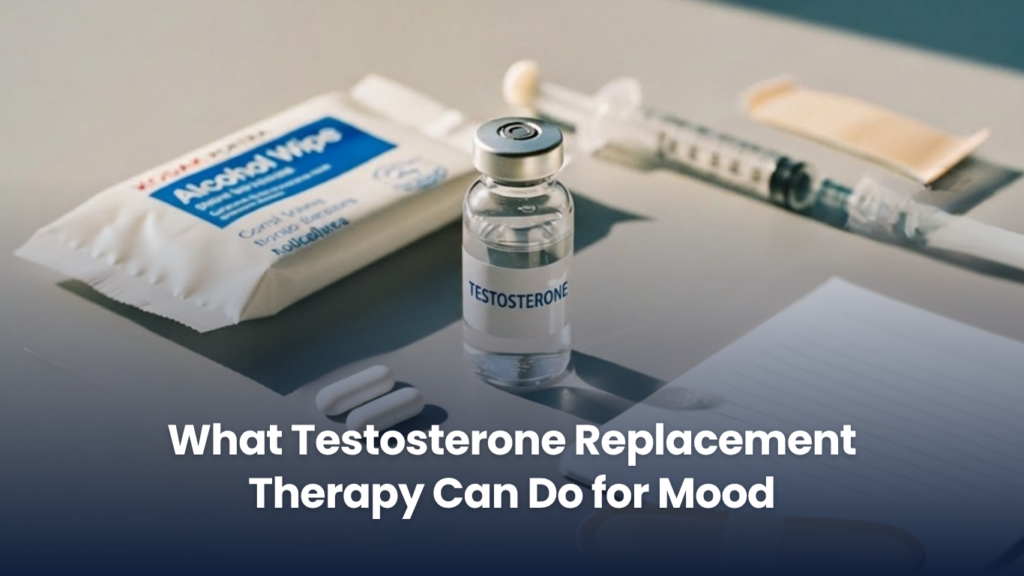 What Testosterone Replacement Therapy Can Do for Mood
For men whose emotional struggles are rooted in low testosterone, TRT produces outcomes that antidepressants alone often cannot. A systematic review of twenty-seven randomized placebo-controlled trials involving 1,890 men found that testosterone treatment was associated with a statistically and clinically significant reduction in depressive symptoms. Key findings from the research:
- Clinically relevant mood improvement was observed in men with both standard depression and treatment-resistant depression
- Effects on depressive symptoms typically became measurable after 6 weeks of TRT
- Men already on antidepressants who initiated TRT showed additional mood improvement beyond what antidepressants alone achieved
As TRT Nation outlines in their post “From Surviving to Thriving: What Happens to Your Body at Month 2 vs. Month 6 on TRT”, most men begin noticing improvements in energy, mood, and mental clarity within four to eight weeks of starting treatment. The physical and psychological transformation builds progressively from there. Testosterone replacement therapy at TRT Nation is medically supervised, individually calibrated, and regularly monitored. It is not a one-size-fits-all prescription, it is a clinical process guided by labs, symptoms, and ongoing provider communication.
 Addressing the Fear: What Men Worry About
Fear is one of the most powerful barriers between a man suffering from low testosterone disguised as depression and the care that could change his life. These concerns are worth addressing directly:
- “Is TRT safe?” When medically supervised by providers with appropriate lab monitoring, testosterone replacement therapy has a well-established safety profile. TRT Nation requires baseline labs, ongoing monitoring, and regular provider check-ins to ensure long-term safety.
- “Will I have to stay on it forever?” Not necessarily. Some men use TRT as a long-term health strategy because they feel and function better. Others use it as a corrective intervention. TRT Nation helps each patient define goals and plan accordingly, including safe transition protocols for men who eventually choose to discontinue.
- “What if my testosterone levels test as ‘normal’?” Reference ranges reflect statistical population averages, not individual optimal levels. TRT Nation providers evaluate symptoms alongside labs and use clinical judgment to assess the full picture.
- “I’m worried this means something is wrong with me.” Low testosterone is not a character flaw. It is a medical condition. Testosterone naturally begins declining after age 30, and many additional factors — chronic stress, poor sleep, environmental exposures, and genetics, can accelerate this decline. Getting evaluated is not weakness. It is clarity.
If any of these fears resonate, consider taking TRT Nation’s Hormone Readiness Assessment as a low-pressure first step. It is a simple way to understand where you stand before committing to anything.
 Getting Started: What the Process Looks Like at TRT Nation
TRT Nation operates as a fully online telehealth platform, which means there are no waiting rooms, no awkward in-person conversations, and no complicated logistics. The process is designed to be straightforward and respectful of your time.
- Complete your intake forms and upload lab results (or order labs through TRT Nation)
- Consult with a licensed provider via telehealth video, providers who specialize exclusively in hormone optimization, not generalists
- Receive a personalized protocol calibrated to your labs, symptoms, and goals
- Medications are dispensed through regulated U.S. pharmacies and shipped to your door within 10 business days of consultation
- Ongoing provider access, lab monitoring, and protocol adjustments are part of the care relationship, not afterthoughts
 Frequently Asked Questions
Can low testosterone cause depression, or just mimic it?
Low testosterone can both cause and mimic depression, the distinction matters less clinically than identifying it. Because testosterone directly regulates dopamine and serotonin pathways, a deficiency genuinely disrupts mood, motivation, and emotional stability in ways that are neurochemically identical to depression. If your low mood is rooted in low testosterone, addressing the hormonal deficiency is the intervention that resolves the problem, and TRT Nation specializes in identifying exactly this pattern.
How do I know if my depression is related to low testosterone?
The clearest indicator is a blood test, there is no reliable way to distinguish hormonally driven depression from other forms without measuring testosterone levels. However, warning signs include gradual onset without a clear psychological trigger, physical symptoms like fatigue and low libido alongside low mood, and a poor or incomplete response to antidepressants. If any of these describe your experience, a hormone evaluation is the logical next step, and TRT Nation’s providers are trained to assess the full picture.
Will treating low testosterone make my depression go away?
For men whose depression is hormonally rooted, testosterone replacement therapy has shown clinically significant antidepressant effects in multiple randomized controlled trials, including in men with treatment-resistant depression. Results are not instantaneous; most men notice meaningful mood improvements within four to eight weeks of starting TRT. The goal at TRT Nation is sustainable restoration of hormonal health, not a quick fix, and that sustained improvement is what many men describe as feeling like themselves again.
Is it safe to try TRT if I’ve already been diagnosed with depression?
Yes, in fact, research suggests that men already on antidepressants who initiated TRT showed additional mood improvement beyond what antidepressants alone achieved. TRT Nation’s providers conduct a thorough medical intake that includes your current medications, mental health history, and overall health profile to determine the safest and most effective protocol for your situation. Treating both dimensions, hormonal and psychological, is often the most complete approach.
How long before I know if TRT is helping my mood?
Most men report early improvements in energy, mental clarity, and mood stability within three to five weeks of starting testosterone therapy. More substantial changes in motivation, emotional resilience, and overall sense of vitality typically build over the following months as levels stabilize in the optimal range. TRT Nation’s providers monitor your progress throughout and adjust your protocol based on how your body responds, ensuring the path to feeling better is as direct as possible.