


Transitioning from Enclomiphene to TRT After Having Children: What You Need to Know
Last Updated June 2026
For many men, enclomiphene is the right starting point. It works with the body’s natural hormone signaling system, preserves fertility, and avoids the suppression that comes with exogenous testosterone. But hormonal needs change over time, and once family-planning goals change, some men find that enclomiphene no longer delivers the level of symptom relief they are looking for. The question then becomes: is transitioning to TRT after having children the right move, and how does it work?
This guide is for the man who used enclomiphene intentionally, completed his family, and is now reassessing his long-term hormone health strategy. It is educational, it is clinically grounded, and it is designed to help you make an informed decision alongside a licensed medical provider.
At TRT Nation, the approach to hormone health has always been individualized. Whether you are on enclomiphene, considering testosterone replacement therapy, or somewhere in between, the right protocol is the one that fits your labs, your symptoms, and your goals.
 Understanding the Two Pathways: Enclomiphene and TRT
Before addressing the transition itself, it helps to understand these two separate approaches.
How Enclomiphene Works
Enclomiphene is a selective estrogen receptor modulator, or SERM. It works by blocking estrogen receptors at the hypothalamus and pituitary gland, which removes the negative feedback signal that would otherwise suppress hormone production. The result is an increase in luteinizing hormone (LH) and follicle-stimulating hormone (FSH), which in turn stimulates the testes to produce more of their own testosterone. The body’s natural hormone axis remains intact and active.
This mechanism is precisely why enclomiphene became the preferred choice for men who still want to have children. Because it stimulates rather than replaces, it preserves spermatogenesis. Studies referenced by the British Society of Sexual Medicine confirm that enclomiphene achieves testosterone levels comparable to transdermal TRT while maintaining sperm production. For men in their family-building years, that trade-off was often the deciding factor.
You can read more about how enclomiphene works, including what to expect on a supervised protocol.
How TRT Works
Testosterone replacement therapy works differently. Rather than stimulating the body to produce its own testosterone, TRT introduces exogenous testosterone directly. This approach typically produces higher, more consistent testosterone levels and more predictable symptom resolution. It is the established standard of care for men with clinically confirmed hypogonadism and tends to deliver more robust outcomes for men whose symptoms are significant.
The trade-off is that TRT suppresses the HPG axis. Exogenous testosterone tells the brain that there is already enough hormone circulating, so the pituitary stops signaling the testes to produce more. Over time, LH and FSH levels drop, sperm production declines, and the testes may reduce in size. For a man who has already completed his family, these effects are no longer a limiting concern. Read more about the differences and long-term results of each.
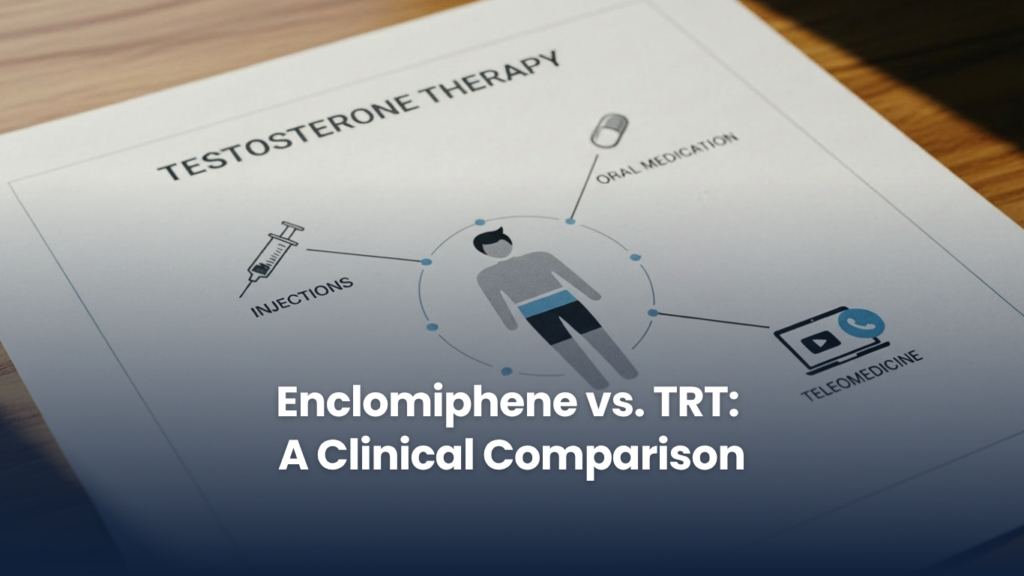 Enclomiphene vs. TRT: A Clinical Comparison
The following table outlines the key clinical differences between enclomiphene and TRT.
| Feature | Enclomiphene | TRT |
| Mechanism | Stimulates natural testosterone production via HPG axis | Replaces testosterone with exogenous hormone |
| Fertility Impact | Preserves or increases sperm production | Suppresses spermatogenesis; reduces fertility |
| Administration | Oral capsule, daily | Injection |
| Testosterone Levels Achieved | Moderate; typically 400–700 ng/dL | Higher and more consistent; depends on dosing |
| Testicular Function | Maintained | May reduce testicular size over time |
| HPG Axis | Remains active | Suppressed during treatment |
| Best For | Men still planning families or preferring natural production | Men who have completed family planning and need stronger symptom control |
| Medical Monitoring | Regular bloodwork required | Regular bloodwork required |
 Why Men Consider Transitioning from Enclomiphene to TRT After Having Children
The most common reason men begin thinking about transitioning from enclomiphene to TRT after having children is straightforward: their family is complete, and their symptoms are not adequately controlled. Enclomiphene is effective for many men, but it does not work equally for everyone, and the ceiling on testosterone levels it can achieve is lower than what direct testosterone therapy provides.
Common reasons men consider this transition include:
- Persistent fatigue, low libido, or brain fog that has not fully resolved on enclomiphene
- Testosterone levels that have plateaued below a therapeutic range
- A preference for the more predictable hormone levels that TRT provides
- Primary hypogonadism or diminished testicular function that limits enclomiphene’s effectiveness
- Life circumstances have changed and fertility preservation is no longer the primary concern
It is worth noting that enclomiphene is specifically effective for men with secondary hypogonadism, where the problem originates in the signaling pathway rather than the testes themselves. Men with primary hypogonadism, where the testes themselves have limited production capacity, may find that enclomiphene provides little benefit regardless of family planning status, making TRT the more appropriate clinical choice from the start.
The TRT Nation Hormone Readiness Assessment is a useful starting point for men who are unsure whether their symptoms and hormone levels support a protocol change.
 What Happens When You Stop Enclomiphene
One of the practical advantages of enclomiphene is that stopping it is generally more straightforward than stopping TRT. Because enclomiphene works by stimulating the body’s own production, the HPG axis remains functional throughout treatment. When enclomiphene is discontinued, hormone levels may begin to decline again, but there is no prolonged recovery period required before TRT can be initiated.
This is meaningfully different from the reverse scenario. Men who stop TRT and want to recover natural testosterone production typically face a recovery period of weeks to months as the HPG axis reactivates. Because enclomiphene keeps that axis engaged the entire time, men transitioning from enclomiphene to TRT after having children typically do not need a washout period before beginning testosterone therapy. The clinical handoff is generally cleaner.
 How the Transition Is Typically Managed
Transitioning from enclomiphene to TRT is a clinical process that should always be managed by a medical provider. The general steps below reflect how this process is typically structured under medical supervision.
| Step | What Happens | Why It Matters |
| 1. Comprehensive Lab Panel | Updated bloodwork including total testosterone, estradiol, CBC, and metabolic markers | Establishes your hormonal baseline before making any changes and confirms candidacy for TRT |
| 2. Clinical Consultation | A licensed provider reviews your labs, symptoms, history, and goals | Determines whether TRT is the appropriate next step and which delivery method suits your lifestyle |
| 3. Discontinue Enclomiphene | Enclomiphene is stopped; no structured taper is generally required | Because the HPG axis remains active, the transition is cleaner than stopping exogenous testosterone |
| 4. Initiate TRT Protocol | Testosterone therapy is started at a clinically appropriate dose and delivery method | Establishes the new hormone baseline; ongoing monitoring ensures proper calibration |
| 5. Follow-Up Bloodwork | Labs are repeated to assess response | Allows for dose adjustment and monitoring of hematocrit, estradiol, and other key markers |
 What to Expect After Starting TRT
Once TRT is initiated, the timeline for noticeable improvement follows a predictable pattern. Most men begin noticing changes in energy, mood, and libido within the first four to six weeks. Improvements in body composition, muscle mass, and sexual function typically continue to develop over the following three to six months as testosterone stabilizes at a consistent therapeutic level.
The key changes men commonly report after initiating TRT include:
- Improved energy levels and reduced daytime fatigue within the first month
- Increased libido and improvements in sexual function, typically within four to six weeks
- Gradual increase in lean muscle mass and reduction in body fat over three to six months
- Improved mood stability, mental clarity, and motivation
- Better sleep quality, which compounds improvements in other areas over time
It is important to understand that TRT is a long-term commitment. Unlike enclomiphene, which can be stopped with the HPG axis resuming function, stopping TRT after extended use requires a structured protocol to allow the body’s natural hormone production to reactivate. This is a clinical consideration that should be part of the conversation before starting therapy, not after.
The TRT Nation blog on fertility-friendly testosterone therapies is a useful resource for understanding the full range of options available and how they compare in terms of outcomes and long-term management.
 Is Transitioning from Enclomiphene to TRT the Right Decision for You?
There is no universal answer to this question, and any provider who tells you otherwise is not giving you good clinical guidance. The decision to transition from enclomiphene to TRT depends on a combination of factors that are specific to your physiology, your lab results, your symptoms, and your goals.
You may be a strong candidate for TRT if:
- Your family is complete and fertility preservation is no longer a priority
- Your enclomiphene protocol has been optimized but testosterone levels remain below range
- Your symptoms, including fatigue, low libido, or mood changes, have not fully resolved
- You are looking for the stronger, more consistent hormone optimization
You may want to stay on enclomiphene or explore other options if:
- Your testosterone levels are within a healthy range and your symptoms are well managed
- You want to preserve the option of future fertility, even if not actively planning for children now
- You prefer a treatment that works with your body’s natural signaling rather than replacing the hormone externally
Not sure where you stand? Taking the TRT Nation Hormone Readiness Assessment is a practical first step that can help clarify whether your current protocol is still the right fit or whether it is time to explore a new direction.
 The Importance of Ongoing Monitoring on TRT
One of the most important aspects of testosterone replacement therapy is consistent medical oversight. TRT is not a “set it and forget it” treatment. As your body adjusts to exogenous testosterone, several markers require regular attention.
Key monitoring parameters on TRT include:
| Marker | Why It Is Monitored |
| Total Testosterone | Confirms levels are within therapeutic range |
| Estradiol | TRT can increase estrogen conversion |
| PSA (Prostate-Specific Antigen) | Monitors prostate health, particularly in men over 40 |
| Metabolic Panel | Monitors kidney and liver function |
At TRT Nation, monitoring is built into every protocol. Providers review bloodwork at structured intervals, adjust dosing when needed, and remain accessible for questions between appointments. This level of oversight is what separates a well-managed TRT protocol from one that creates more problems than it solves.
 Frequently Asked Questions (FAQs)
Can I switch from enclomiphene to TRT at any time after having children?
Yes, but the transition should always be guided by current bloodwork and a consultation with a licensed hormone specialist. The fact that your family is complete removes fertility preservation as a clinical concern, but it does not mean TRT is automatically the right next step. Your labs, symptom severity, and overall health profile all factor into that decision. TRT Nation offers telehealth-based evaluations to help men assess whether TRT is the appropriate protocol for their current needs.
Will stopping enclomiphene cause a crash in testosterone before TRT begins?
It is possible to experience a temporary dip in testosterone after stopping enclomiphene, since the drug was stimulating your natural production. However, because enclomiphene keeps the HPG axis active, the decline is generally more gradual than what occurs when stopping exogenous testosterone. Clinical pharmacology data shows that enclomiphene’s gonadotropin-stimulating effects can persist for up to a week after discontinuation. Working with a provider to time the transition properly minimizes any symptomatic gap between the two protocols. At TRT Nation, providers coordinate this handoff carefully to keep symptoms stable throughout the process.
Is TRT a permanent commitment once I start?
TRT is a long-term therapy for most men, but it is not irreversible. Because exogenous testosterone suppresses the HPG axis, stopping TRT typically requires a structured recovery protocol to allow natural production to resume. How well that recovery goes varies by individual and by how long a man has been on therapy. This is one reason why the decision to start TRT deserves thoughtful clinical evaluation upfront rather than an impulsive change. TRT Nation providers address this conversation before initiating any protocol.
How long does it take to feel the effects of TRT after transitioning from enclomiphene?
Most men begin noticing early improvements in energy, mood, and libido within four to six weeks of starting TRT. More substantial changes in body composition, muscle mass, and sexual health typically emerge over three to six months as testosterone stabilizes. Because men transitioning from enclomiphene already have a foundation of hormone optimization, the shift to TRT often feels more like a recalibration than a dramatic change. Your TRT Nation provider will use follow-up bloodwork to confirm that your levels are optimized and adjust the protocol if needed.
Does transitioning from enclomiphene to TRT require a washout period?
Generally, no structured washout period is required when transitioning from enclomiphene to TRT after having children. Since enclomiphene stimulates natural production and keeps the HPG axis functional, there is no prolonged suppression that needs to be reversed before TRT can be initiated. This is one of the clinical advantages of starting with enclomiphene. That said, exact timing should always be confirmed with your provider based on your specific labs and protocol. TRT Nation coordinates these transitions as part of its comprehensive telehealth-based care model.