

Why Your Training Isn’t Building Muscle: The Testosterone Factor No One Talks About
If you’re in your mid-to-late twenties, hitting the gym 4–5 times a week, tracking lifts or macros, and still struggling to build muscle or lose stubborn fat…you’re not alone. And you’re definitely not lazy.
The fitness industry has sold you a lie: that effort always equals results. But what happens when you’re doing everything right and your body still isn’t responding?
This article explains the physiological reality most training content ignores: why hormonal baseline matters, what testosterone replacement therapy (TRT) actually does, and how to know if low testosterone is limiting your gains.
No hype. No shortcuts. Just the science of why some men struggle despite consistent effort.
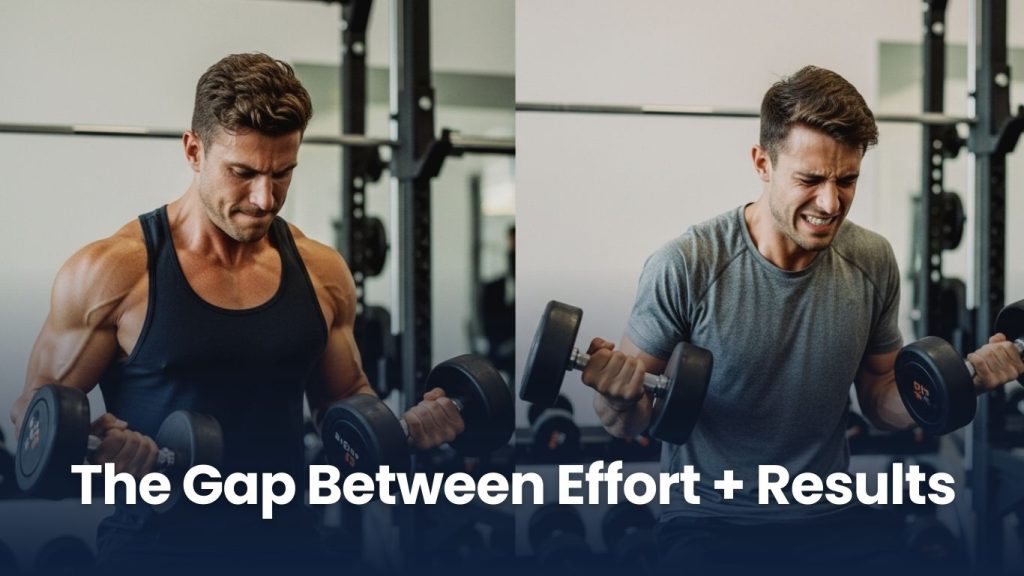
The Gap Between Effort + Results: Why Your Hard Work Doesn’t Always Build Muscle
You’ve probably noticed: two guys follow the same program, eat similar macros, sleep reasonably well, yet one packs on lean mass while the other spins his wheels.
The difference isn’t the first’s willpower is stronger than the other. It’s his signal strength, aka hormones.

How Testosterone Affects Muscle Growth and Recovery
Training creates the stimulus. Hormones determine how your body responds to that stimulus.
Testosterone directly influences:
- Muscle protein synthesis: How efficiently your body builds new muscle tissue
- Recovery speed: How quickly you bounce back between training sessions
- Body composition: Where your body stores fat versus building lean mass
- Training capacity: Your ability to generate force and handle volume
- Red blood cell production: Oxygen delivery to working muscles
When testosterone levels are suboptimal, even if technically “within range”, your body still adapts to training. It just does so slowly, inconsistently, and with disproportionate fatigue relative to the work you’re putting in.
Why Low Testosterone in Your 20s Is More Common Than You Think
Environmental factors, stress, sleep disruption, dietary patterns, and metabolic health all impact testosterone production. Men in their twenties aren’t immune.
If your testosterone sits at the lower end of the “normal” range (300–400 ng/dL when the range extends to 1000+ ng/dL), you’re technically not deficient. But you may be operating at a hormonal baseline that makes every percentage point of progress harder to achieve.
That’s not an excuse. It’s physiology.
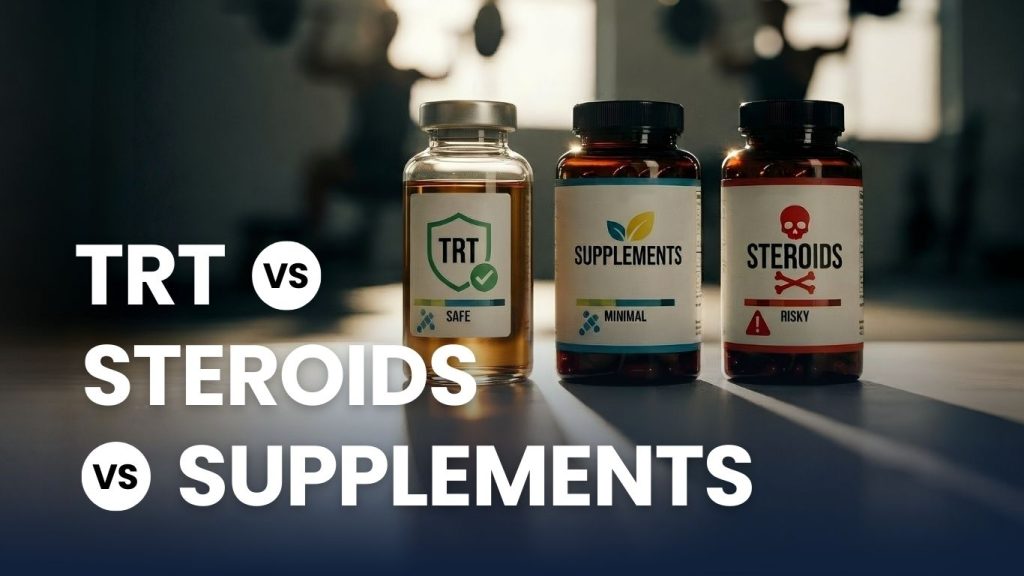
TRT vs Steroids vs Supplements: Understanding the Difference
Let’s define terms clearly, because confusion here drives most of the skepticism around testosterone replacement therapy (TRT).
Anabolic Steroids (Performance-Enhancing Drugs)
What they are: Supraphysiological doses of testosterone or synthetic androgens designed to push hormone levels far beyond natural human ranges.
Typical doses: 500+ mg per week (often much higher)
Goal: Rapid muscle growth, enhanced performance beyond natural limits
Risk profile: Significant, cardiovascular strain, liver stress (oral compounds), shutdown of natural production, potential for long-term damage
Testosterone Supplements (OTC Products)
What they are: Vitamins, herbs, and minerals marketed to “boost testosterone naturally”
Effectiveness: Minimal, may help if you’re deficient in specific micronutrients (zinc, vitamin D, magnesium), but won’t meaningfully raise testosterone if you’re already adequate
Role: Useful for addressing deficiencies; not a solution for low testosterone production
Testosterone Replacement Therapy (TRT)
What it is: Medically supervised hormone optimization that brings testosterone levels into a healthy physiological range (typically 600–1000 ng/dL)
Typical doses: 100–200 mg per week, adjusted based on blood work
Goal: Restore normal hormonal function, not exceed it
Risk profile: Manageable when properly monitored, requires regular blood work to track hematocrit, lipid panels, estrogen levels, and liver function
TRT doesn’t make you superhuman. It removes the brake that’s been preventing or stalling your training from producing normal results.
Imagine an invisible ceiling finally being lifted, allowing your body to fully absorb the rewards of your hard work. Before testosterone replacement therapy, men often describe feeling chronically fatigued, mentally foggy, and easily depleted. After starting TRT, they describe a profound shift, experiencing a surge in energy, renewed confidence, and the tangible physical progress they’ve been working on for years.
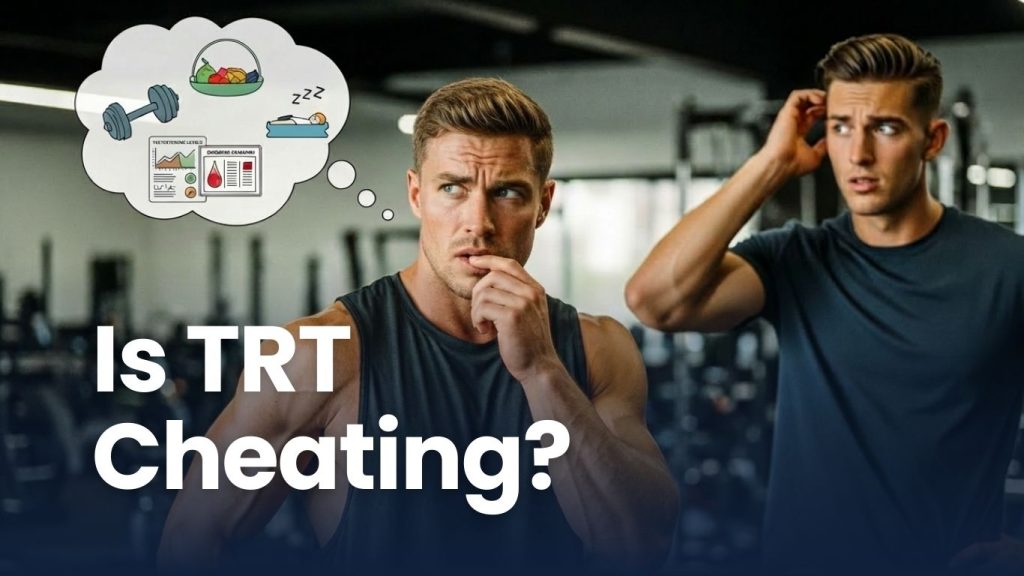
Is TRT Cheating? The Performance Optimization Question
Here’s the real question: If you’re willing to optimize sleep, nutrition, supplementation, and training programming, why is optimizing your hormonal baseline considered “cheating” For a lot of men in their twenties, the hesitation isn’t resistant of medical support, it’s identity. They have the fear that needing hormonal support means something is ‘wrong with you’. It doesn’t. It means you’re willing to measure reality instead of guessing.
TRT Doesn’t Replace Discipline
Men on properly managed TRT still need to:
- Train with progressive overload
- Consume adequate protein and calories
- Manage stress and recovery
- Stay consistent over months and years
TRT doesn’t build muscle. It allows your body to respond normally to the training stimulus you’re already providing.
If you’re not training hard, eating enough, or sleeping well, TRT won’t fix that. If anything, it makes the feedback loop more honest, you can’t hide behind the excuse of “maybe my hormones are off” anymore.
The Real Comparison
Consider these interventions:
- Correcting vitamin D deficiency: Not cheating
- Using creatine monohydrate: Not cheating
- Physical therapy for mobility restrictions: Not cheating
All of these remove physiological constraints that limit training adaptation. TRT is in the same category.
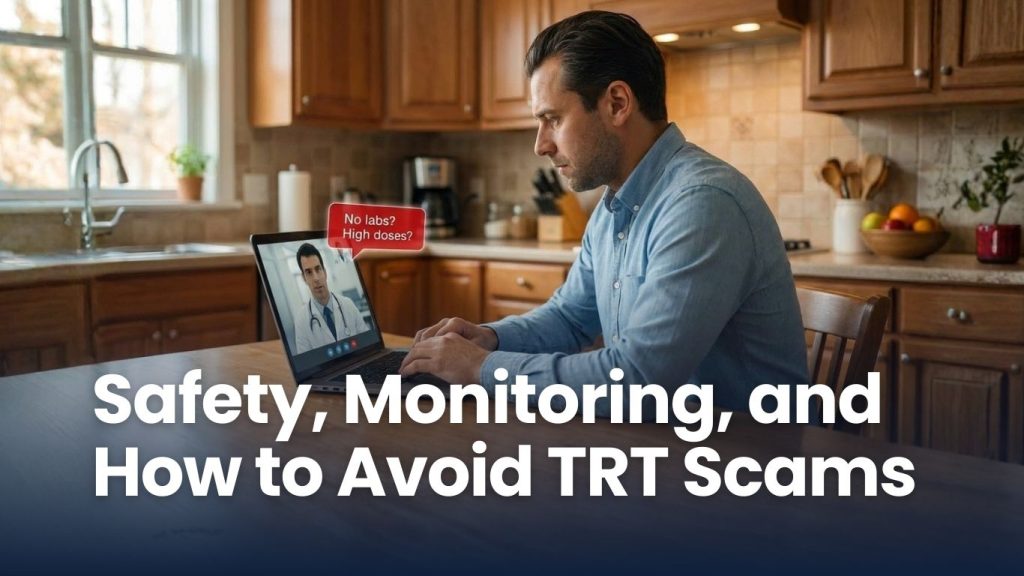
Safety, Monitoring, and How to Avoid TRT Scams
Your skepticism about online testosterone clinics is rational. The industry has been flooded with aggressive marketing, influencer testimonials, and clinics that prioritize profit over patient safety.
Red Flags: How to Spot TRT Scams
Avoid clinics that:
- Start treatment without comprehensive baseline blood work
- Promise specific physique outcomes or “alpha male transformations”
- Use identical protocols for every patient regardless of labs
- Don’t require follow-up testing at regular intervals
- Market primarily through shredded influencers and aggressive social media ads
- Prescribe doses higher than 200 mg/week without clinical justification
What Legitimate TRT Clinics Looks Like
Responsible clinics will:
- Require baseline labs before any prescription
- Schedule follow-up labs at 6-8 weeks
- Adjust dosing based on symptoms and biomarkers
- Monitor for side effects (elevated red blood cells, estrogen conversion, cardiovascular markers)
- Be willing to say “not yet” or “this isn’t appropriate for you”
- Provide clear information about fertility considerations and off-ramps
Real medical TRT is boring. It’s data-driven, conservative, and focused on long-term health, not quick transformations.
Understanding Your Baseline: Should You Get Tested?
Not everyone needs TRT. Many men in their twenties have perfectly adequate testosterone levels and would see better results from improving:
- Sleep quality and duration
- Stress management
- Body fat percentage (excess adipose tissue increases aromatase activity, converting testosterone to estrogen)
- Micronutrient status
- Training programming and recovery
When to Consider Testosterone Testing
You should get baseline labs if you’re experiencing:
- Persistent fatigue despite adequate sleep
- Difficulty building muscle despite consistent progressive overload
- Stubborn fat retention even at lower body fat percentages
- Low libido or sexual dysfunction
- Brain fog, difficulty concentrating
- Disproportionate soreness or slow recovery between sessions
Getting tested is the first step toward reclaiming your health, but it’s just as important to manage your expectations in a world of ‘fitness influencers’ and carefully curated feeds. The line between medical therapy and performance enhancement has become dangerously blurred.

The Influencer Problem: Managing Expectations
Most physiques you see online are not the result of TRT. They are the product of extreme doses, elite genetics, and a lack of transparency that sets an impossible standard for the average man. We’re talking doses well beyond therapeutic ranges, full-time training and nutrition (remember their physique pays the bills), strategic + professional photography, lighting, and editing, and sometimes additional peptides to enhance growth hormones and other compounds.
TRT alone will not turn you into an Instagram fitness model.
What TRT can do, if you actually need it, is allow your training to produce the results it should have been producing all along. For performance-focused lifters, this usually shows up first as improved recovery between sessions, more consistent strength progression, and less need for extended deloads.
That might mean:
- Gaining 10-15 pounds of lean mass over a year instead of 3-5
- Recovering fully between sessions instead of feeling chronically run down
- Losing the last stubborn fat while maintaining muscle
- Training with intensity that previously left you wrecked for days
These are meaningful improvements. They’re not superhuman transformations.
The Real Question Isn’t “Should I Try TRT?”
The question is: What’s actually limiting my progress?
That requires:
- Honest assessment of training, nutrition, sleep, and stress
- Objective data from blood work
- Context from a qualified healthcare provider
- Patience to rule out simpler explanations first
For some men in their twenties, the answer will be hormonal optimization. For many others, the answer will be better programming, more food, less stress, or improved sleep.
TRT is a tool, for a specific problem.
Final Thoughts: Intelligence Over Hype
You’re right to be skeptical of Testosterone Replacement Therapy content online. Most of it is either fear-mongering or selling you a lifestyle.
But if you’re consistently training hard, eating well, sleeping enough, and still seeing minimal progress, while feeling chronically fatigued, don’t default to “just work harder.”
Get data. Understand your baseline. Rule out other factors. And if testosterone is genuinely limiting your ability to adapt to training, address it like you would any other physiological constraint.
That’s not cheating. That’s not a shortcut.
That’s using every available tool to make your effort count.
If you’re ready to understand whether testosterone is limiting your progress, start with comprehensive blood work. Not a sales pitch. Not a protocol. Just data.
Because you deserve to know what’s actually holding you back.