


How Much Does Enclomiphene Raise Testosterone?
Last Updated April 2026
If you have been researching options for low testosterone, you have likely come across enclomiphene and wondered: how much does enclomiphene raise testosterone, and is it enough to make a real difference? The short answer is that clinical studies show meaningful, measurable increases in total testosterone, and many men achieve levels well within the healthy normal range, all without the use of synthetic hormones.
This guide breaks down what researchers say about how much enclomiphene raises testosterone, how it compares to other options, what timeline to expect, and who is likely to benefit the most. Whether you are new to hormone optimization or comparing your options, this is the information you need to make an informed decision.
 What Is Enclomiphene and How Does It Work?
Enclomiphene is a selective estrogen receptor modulator, commonly abbreviated as a SERM. Unlike testosterone replacement therapy (TRT), which introduces synthetic testosterone into the body from the outside, enclomiphene works by communicating with the body’s own hormone-signaling system to encourage the testes to produce more of their own testosterone.
Specifically, enclomiphene blocks estrogen receptors in the hypothalamus and pituitary gland. This action removes the estrogen-based negative feedback loop that normally tells the brain to dial back hormone output. With that brake released, the pituitary increases its release of luteinizing hormone (LH) and follicle-stimulating hormone (FSH), both of which signal the testes to ramp up natural testosterone production.
This is an important distinction. When asking how much does enclomiphene raise testosterone, the answer involves understanding that the rise is driven by your own biology, not an external hormone source. The testes do the work; enclomiphene simply removes a signal that was holding them back. To learn more about how it compares to other testosterone-supporting options, see TRT Nation’s guide to the “Best Low Testosterone Options for 2026.”
 How Much Does Enclomiphene Raise Testosterone? What Clinical Research Shows
This is the question most men want answered with real numbers. Clinical research provides a clear and encouraging picture. Here is what the peer-reviewed data shows:
| Study / Source | Starting Testosterone | Result After Treatment | Dose |
| Fertility & Sterility (2004) | 275 ng/dL average | 412-589 ng/nL (dose-dependent, within 14 days) | 12.5-50 mg daily |
| Journal of Men’s Health | Low/below normal | 400-700 ng/dL range maintained | 25 mg daily |
| PMC/Translational Andrology & Urology (2024) | < 300 ng/dL (hypogonadal) | Median increase of 166 ng/dL | Varied |
| Phase II Study (6 weeks) | < 350 ng/dL | 604 ng/dL average at 25 mg dose | 25 mg daily |
These numbers tell a consistent story. Men with clinically low testosterone, typically defined as levels below 300 ng/dL, can see their levels climb into the 400 to 600 ng/dL range, sometimes higher, within a matter of weeks. The normal reference range for total testosterone in adult men is generally considered to be 300 to 1,000 ng/dL, and many men on enclomiphene land comfortably within that window.
A 2024 study published in the National Center for Biotechnology Information (NCBI) reviewed 66 hypogonadal men and found enclomiphene produced a median testosterone increase of 166 ng/dL on average. That study also found that estradiol levels were better controlled with enclomiphene, an important factor for men who want to avoid estrogenic side effects.
A separate 14-day pharmacokinetic study published in Fertility and Sterility showed dose-dependent increases from a baseline average of 275 ng/dL. Men taking 12.5 mg reached approximately 412 ng/dL, men on 25 mg reached roughly 520 ng/dL, and the 50 mg group averaged around 589 ng/dL, all within the clinically normal range.
A longer six-week randomized study found men on 25 mg of enclomiphene daily achieved total testosterone of 604 ng/dL, on average. The results were published on PubMed Central and represent some of the strongest clinical evidence available.
 How Quickly Does Enclomiphene Raise Testosterone?
Speed of response is another key part of answering how much enclomiphene raises testosterone, because results that take years to appear are far less useful than results that appear in weeks. The good news: enclomiphene works quickly relative to many other approaches.
Here is a general timeline based on clinical data and real-world use:
- Within 2 weeks: Research indicates that some men with low testosterone can achieve normal testosterone levels within two weeks of starting enclomiphene. LH and FSH levels rise quickly as the estrogen feedback loop is disrupted.
- Weeks 2 to 4: Most men notice early symptom changes, including improved energy, better mood, and increased motivation.
- Weeks 4 to 8: Testosterone levels continue rising toward a stable range. Libido, focus, and physical performance improvements often become more noticeable.
- 3 to 6 months: Sustained optimization. Body composition improvements, strength gains, and other longer-term benefits are typically observed in this range with consistent treatment.
These timelines apply to men who are consistent with their protocol and are receiving appropriate monitoring. Individual responses vary based on age, baseline hormone levels, overall health, and treatment dose.
 What Results Do Men Notice When Enclomiphene Raises Testosterone?
Understanding how much enclomiphene raises testosterone in terms of laboratory numbers is important. But the more meaningful question for most men is: what does that testosterone increase feel like?
Men who respond well to enclomiphene commonly report improvements across several areas:
| Area | Common Reported Changes |
| Energy and Fatigue | Reduced daytime exhaustion, more consistent energy throughout the day |
| Mood and Mental Clarity | Less irritability, sharper focus, reduced brain fog |
| Libido | Improved sex drive and sexual function |
| Body Composition | Easier to build or maintain muscle; gradual reduction in midsection fat |
| Motivation | Increased drive and competitive edge |
| Sleep | Better quality sleep reported by some men as levels stabilize |
These improvements align closely with the known effects of testosterone on male physiology. Because enclomiphene raises testosterone through the body’s own production, the hormonal profile tends to remain balanced, with natural regulation of downstream hormones including LH and FSH remaining intact.
If you are unsure whether your symptoms might be related to low testosterone, the Hormone Readiness Assessment is a straightforward tool that can help you understand whether your symptoms align with commonly recognized indicators of low T.
 Who Is a Good Candidate for Enclomiphene?
Enclomiphene is not the right solution for every man with low testosterone, but it is an excellent option for a specific group. Understanding this helps you interpret the research more accurately and ask better questions when working with a provider.
Enclomiphene tends to be most appropriate for men who:
- Have secondary hypogonadism, meaning their low testosterone is caused by a signaling issue in the brain rather than a primary failure of the testes
- Want to preserve fertility and testicular function, since enclomiphene does not suppress sperm production the way traditional TRT can
- Prefer an oral medication over weekly injections
- Are in the earlier stages of testosterone decline and still have functional testicular capacity
- Want to support their own natural hormone axis rather than relying on synthetic testosterone
Men with primary hypogonadism, where the testes themselves are unable to produce testosterone even when properly signaled, may not respond as well to enclomiphene because the underlying production capacity is impaired. A proper lab workup is essential to determine which approach is appropriate.
For men weighing their options, TRT Nation offers licensed, telehealth-based evaluations to help determine which treatment path aligns with your labs, symptoms, and goals.
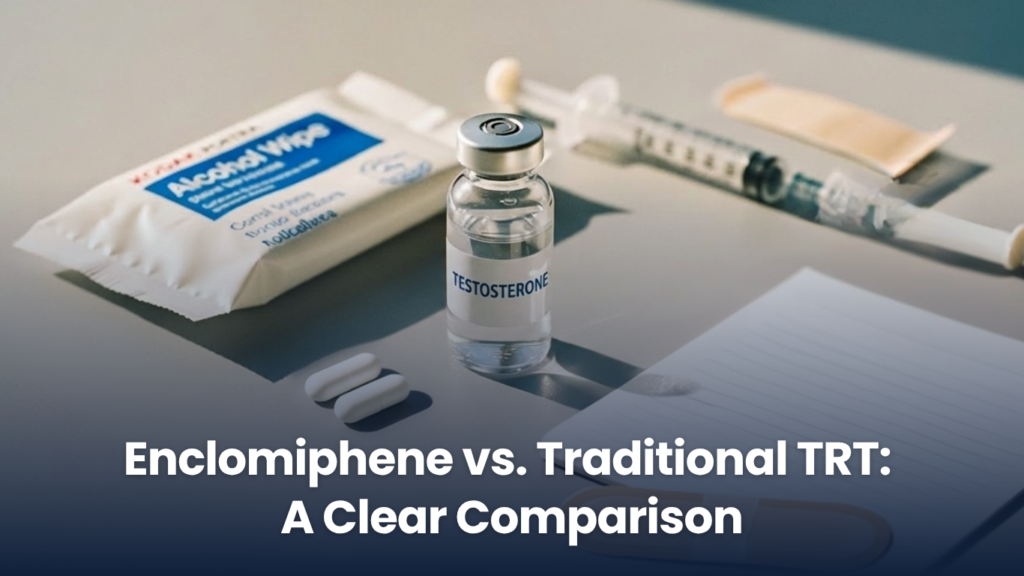 Enclomiphene vs. Traditional TRT: A Clear Comparison
When men ask how much does enclomiphene raise testosterone, they often want to know how it stacks up against traditional TRT, which involves directly injecting synthetic testosterone. The comparison is worth understanding clearly.
| Factor | Enclomiphene | Traditional TRT |
| Method | Oral daily pill (SERM) | Injections |
| Mechanism | Stimulates natural testosterone production via LH/FSH | Replaces testosterone directly from external source |
| Testosterone Range | Typically 400–700 ng/dL; dose-dependent | Variable; can reach higher levels depending on dose |
| Fertility Preservation | Yes; maintains sperm production | No; typically suppresses spermatogenesis |
| Testicular Function | Preserved | Often suppressed over time |
| Estradiol Effect | Neutral to slight decrease | Can increase, requires monitoring |
| Natural Hormone Axis | Intact; body continues regulating | Suppressed; body stops producing on its own |
| Typical Timeline for Effect | 2 to 4 weeks for lab changes; 4 to 8 weeks for symptom changes | 2 to 4 weeks for lab changes; 4 to 8 weeks for symptom changes |
The key takeaway is that traditional TRT typically reaches higher absolute testosterone numbers but comes with trade-offs including suppression of natural production and fertility. Enclomiphene keeps the body’s own system engaged, which many men find preferable, especially those who have not yet ruled out future family planning. For a deeper understanding, read TRT Nation’s guide to fertility-friendly testosterone therapies.
 Is Enclomiphene Safe? What the Research Indicates
Safety is a reasonable concern when evaluating any hormone-related treatment. The clinical picture for enclomiphene is encouraging. The 2024 study published in Translational Andrology and Urology found that adverse effects were significantly less frequent with enclomiphene compared to clomiphene citrate. Specifically, enclomiphene was associated with lower rates of decreased libido, reduced energy, and mood changes, all common complaints with clomiphene. Regression analysis confirmed lower overall odds of adverse events.
General safety observations from available research include:
- Enclomiphene does not appear to negatively affect semen parameters or sperm counts
- Estradiol changes with enclomiphene are minimal to slightly negative, reducing the risk of estrogen-related side effects
- No significant liver toxicity has been reported in published studies at standard doses
- The hormone changes produced are physiological, meaning they stay within normal biological ranges rather than pushing testosterone to supraphysiologic levels
As with any medication, enclomiphene should be used under the supervision of a licensed provider who can monitor your labs and adjust the protocol as needed. This is a cornerstone of how TRT Nation approaches care: licensed providers, regular lab monitoring, and individualized treatment protocols.
 Factors That Influence How Much Enclomiphene Raises Testosterone
Not every man will see the same numbers. When evaluating how much enclomiphene raises testosterone for your specific situation, several variables come into play:
- Baseline testosterone level: Men with lower starting levels generally see larger absolute increases. If your baseline is 150 ng/dL, a 200 ng/dL rise brings you to 350; if your baseline is 250 ng/dL, the same rise brings you to 450.
- Dose: Clinical research clearly shows a dose-dependent relationship. The 12.5 mg dose produces more modest increases than 25 mg, which in turn differs from 50 mg. A provider will calibrate this based on your response.
- Type of hypogonadism: Secondary hypogonadism, where the testes are functional but under-stimulated, responds best. Primary hypogonadism, where the testes are damaged or non-functional, may not respond adequately.
- Age and overall health: Younger men with otherwise healthy endocrine systems tend to have stronger responses. Conditions like obesity, diabetes, or sleep apnea can affect testosterone levels and treatment response.
- Lifestyle factors: Sleep quality, resistance training, nutrition, and stress management all influence baseline testosterone and how effectively the body responds to treatment.
 How to Get Started with Enclomiphene
If you are asking how much enclomiphene raises testosterone because you are considering it for yourself, the most important next step is a proper evaluation. Enclomiphene is a prescription medication, and it should be prescribed and monitored by a licensed provider based on your actual lab results.
A standard evaluation typically includes:
- A morning total testosterone blood test (ideally on two separate occasions to confirm results)
- LH and FSH levels to confirm the type of hypogonadism
- Additional labs such as estradiol, complete blood count (CBC), and a comprehensive metabolic panel
- A symptom review and medical history discussion
Once your labs confirm low testosterone and appropriate candidacy for enclomiphene, a licensed provider can structure a protocol around your results and goals. TRT Nation provides telehealth-based consultations and individualized treatment plans, including enclomiphene as part of comprehensive hormone optimization protocols. Their approach combines clinical oversight with transparent, ongoing provider access, making it easy for men to get the support they need without unnecessary barriers.
You can also explore additional educational content on low testosterone at the TRT Nation blog, including articles on fertility-friendly therapies and how enclomiphene integrates with broader treatment plans.
 Frequently Asked Questions
How much does enclomiphene raise testosterone on average?
Clinical studies show enclomiphene raises testosterone by a median of approximately 166 ng/dL in real-world hypogonadal populations, with dose-dependent studies showing men reaching total testosterone levels between 400 and 700 ng/dL at standard doses. Individual results vary depending on baseline levels, dose, and the type of hypogonadism present. At TRT Nation, providers use your actual lab values to set realistic and evidence-based expectations.
How long does it take for enclomiphene to raise testosterone?
Most studies show measurable increases in LH, FSH, and total testosterone within 14 days of starting enclomiphene, with continued improvement over the following four to eight weeks. Symptomatic improvements, like better energy and libido, often become noticeable in the first four to six weeks. The TRT Nation team monitors lab values and symptom progress to ensure your protocol is delivering results on schedule.
Does enclomiphene raise testosterone as effectively as TRT injections?
Enclomiphene raises testosterone into the normal physiological range and has shown comparable results to transdermal testosterone in several studies, though traditional TRT injections can achieve higher absolute levels. The advantage of enclomiphene is that it preserves fertility and natural hormone axis function, which injections typically suppress. TRT Nation providers prioritize individualized care, allowing men make informed decisions.
How do I know if enclomiphene is right for me?
The most reliable way to determine candidacy for enclomiphene is through a thorough lab evaluation, including total testosterone, LH, and FSH levels, combined with a clinical review of your symptoms and health history. Men with secondary hypogonadism, those whose testes are functional but under-stimulated, tend to respond best. Starting with the TRT Nation Hormone Readiness Assessment is a useful first step before scheduling a full consultation.