


You Have Low T. You Don’t Want Needles. Here’s What You Need to Know About Enclomiphene.
Last Updated May 2026
You already know something is off. The energy you used to have isn’t there anymore. Your drive, in the gym, at work, in the bedroom, has quietly faded. You’ve searched your symptoms, and every sign points to low testosterone. But when you investigate treatment, the word “injections” stops you cold. Maybe it’s the needle itself. Maybe it’s the idea of committing to weekly shots. Whatever the reason, the fear is real, and you’re not alone.
Here’s what most men in your position don’t know yet: injections are not your only path out of low testosterone. Enclomiphene for low testosterone without injections is a clinically studied, orally administered option that works with your body’s own hormone production, no needles required. This guide will walk you through exactly what enclomiphene is, how it works, who it is right for, and how to get started with licensed providers at TRT Nation.
 Understanding Low Testosterone: What It Actually Does to You
Testosterone is not just a “macho” hormone. It is the foundation of male energy, metabolism, mood, sexual function, and physical composition. Starting around age 30, men naturally begin to lose about 1% of their testosterone per year. For some men, that decline is gradual and manageable. For others, it tips into clinical low testosterone, a condition known as hypogonadism, and the impact on daily life is significant.
Common signs that low testosterone may be affecting you include:
- Persistent fatigue that sleep does not fix
- Reduced libido or sexual performance issues
- Loss of muscle mass or difficulty building strength
- Increased body fat, especially around the midsection
- Brain fog, poor concentration, or low motivation
- Irritability, low mood, or feelings of depression
- Decreased bone density over time
If several of those feel familiar, it may be worth taking the Hormone Readiness Assessment to see how low testosterone might be affecting your life. A simple quiz and follow-up blood test can give you clarity on where your levels stand.
 Why Some Men with Low T Are Afraid of Injections (And Why That Fear Is Valid)
Fear of needles is one of the most common reasons men delay or avoid treating low testosterone. Studies estimate that as many as one in four adults experience significant fear around injections, and for men who are already feeling low and depleted, the idea of committing to a weekly shot can feel like an insurmountable obstacle.
Beyond the fear itself, the practical concerns around injectable testosterone therapy are real:
- Weekly or twice-weekly injections require consistent routine and self-administration
- Hormone levels can fluctuate between doses, creating energy and mood peaks and valleys
- Injectable TRT suppresses the body’s natural testosterone production, which can lead to testicular atrophy and infertility
- Stopping injectable TRT requires a structured recovery protocol because the body has stopped producing testosterone on its own
These are not minor concerns. They are legitimate medical and lifestyle considerations, and they are exactly why the conversation around enclomiphene for low testosterone without injections has grown significantly in recent years.
 What Is Enclomiphene and How Does It Work?
Enclomiphene citrate is an oral selective estrogen receptor modulator, commonly referred to as a SERM. Unlike traditional testosterone replacement therapy, which introduces external testosterone into your body, enclomiphene works by signaling your own brain and testes to produce more testosterone naturally.
It does this by blocking estrogen receptors in the hypothalamus and pituitary gland. When those receptors are blocked, the brain perceives a lower estrogen signal and responds by releasing more gonadotropin-releasing hormone (GnRH). That triggers a release of luteinizing hormone (LH) and follicle-stimulating hormone (FSH), which then tell the testes to produce more testosterone. The entire process works through your body’s existing hormonal architecture, not around it.
The result is an increase in natural testosterone production while the body’s own feedback systems remain intact. This is a fundamentally different approach than conventional TRT, and it explains why enclomiphene for low testosterone without injections has become such a compelling option for men who want real results without needles, without shutting down their natural hormone production, and without sacrificing fertility.
 The Clinical Research Behind Enclomiphene
Enclomiphene is not a new idea. It has been the subject of multiple peer-reviewed clinical trials, and the results are well-documented.
Key findings from published research include:
- A phase II clinical trial published in The Journal of Sexual Medicine found that oral enclomiphene citrate produced significant increases in total testosterone in men with low baseline levels after just two weeks of treatment, while simultaneously elevating LH and FSH and preserving sperm production.
- A study published in BJU International found that after six weeks of daily use, men taking 25mg of enclomiphene citrate reached average total testosterone levels of approximately 604 ng/dL, well within the normal, healthy range.
- Phase III randomized trials confirmed that enclomiphene raised testosterone levels across 16 weeks in overweight men with secondary hypogonadism.
- Research published in Fertility and Sterility confirmed that enclomiphene reverses the two defining features of secondary hypogonadism, low total testosterone and low-to-normal LH, while preserving sperm counts.
- Men with low testosterone can achieve normal levels within two weeks of starting enclomiphene, though individual responses vary.
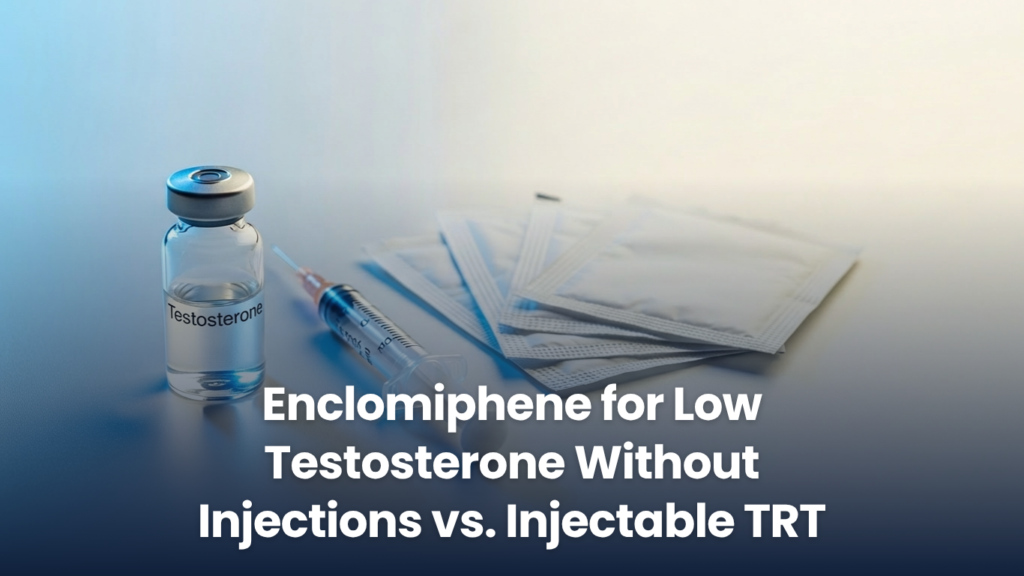 Enclomiphene for Low Testosterone Without Injections vs. Injectable TRT: A Side-by-Side View
Understanding the differences between these two approaches can help clarify which path is right for your life and your goals.
| Feature | Enclomiphene | Injectable TRT |
| Administration | Daily oral pill | Weekly or twice-weekly injection |
| Mechanism | Stimulates natural testosterone production | Replaces testosterone externally |
| Fertility Impact | Preserves sperm production | Typically suppresses sperm production |
| Natural Production | Maintained | Suppressed during treatment |
| Testicular Function | Preserved | May cause atrophy over time |
| Hormone Fluctuation | More stable, follows natural rhythms | Peaks and valleys between doses |
| Stopping Treatment | Natural production resumes more readily | Requires post-cycle recovery protocol |
| Needle Required | No | Yes |
| Supervised by Provider | Yes | Yes |
Both approaches are valid, and the right choice depends on your labs, lifestyle, fertility considerations, and goals. For men who want to avoid injections, enclomiphene is a medically grounded alternative.
 Who Is Best Suited for Enclomiphene?
Enclomiphene is not a one-size-fits-all solution, but it is an excellent fit for a well-defined group of men. You may be a strong candidate for enclomiphene if you:
- Have clinically confirmed low testosterone (secondary hypogonadism), meaning your testes can produce testosterone but are not receiving adequate signaling from the brain
- Have a needle phobia or a strong preference to avoid self-injecting
- Want to preserve your fertility and sperm production while addressing low testosterone
- Prefer a treatment that works with your body’s own hormone systems rather than replacing testosterone externally
- Are experiencing symptoms of low T, fatigue, low libido, muscle loss, brain fog, mood changes, but have not yet tried any treatment
- Are looking for a treatment protocol managed by licensed medical providers with ongoing monitoring
Men with primary hypogonadism, where the testes themselves cannot produce testosterone, are generally not candidates for enclomiphene. A blood panel and provider evaluation through TRT Nation can help determine which category you fall into and what approach makes clinical sense for your situation.
 What to Expect When You Start Enclomiphene
One of the most common questions men have when considering enclomiphene for low testosterone without injections is: how quickly will I feel a difference? Here is a general timeline based on published research and clinical experience:
| Timeframe | What Typically Happens |
| Days 1–14 | Testosterone levels begin to rise as LH and FSH signal the testes to increase production |
| Weeks 2–4 | Many men begin noticing early improvements in energy, mood, and mental clarity |
| Weeks 4–8 | Libido and sexual function often begin to improve; strength and body composition changes begin |
| Months 2–3 | Full benefits typically become more apparent; ongoing monitoring guides dose optimization |
| Ongoing | Regular lab work ensures levels remain in the healthy range and protocol is adjusted as needed |
Individual results vary depending on baseline hormone levels, age, lifestyle factors, and overall health. Licensed providers at TRT Nation work with each patient individually, using lab results to guide dosing and monitoring throughout the treatment process.
 Getting Started: How TRT Nation Supports Men Choosing Enclomiphene
TRT Nation is a licensed telehealth men’s health provider specializing in hormone health. For men who want to address low testosterone without injections, TRT Nation offers a medically supervised enclomiphene protocol that includes provider consultation, lab work guidance, and ongoing monitoring.
Here is what the process generally looks like:
- Start with a blood panel to confirm your testosterone levels and identify whether your low T is secondary in nature (the type enclomiphene addresses)
- Consult with a licensed TRT Nation provider who will review your labs, symptoms, and health history
- Receive a personalized enclomiphene protocol tailored to your levels and goals
- Begin oral treatment, no injections, no clinic visits required
- Receive follow-up monitoring through regular labs and provider check-ins to ensure optimal response
To see whether you might be a candidate, you can take the Hormone Readiness Assessment as a first step, then move into a blood panel and consultation. Knowing your numbers is the most important first move, and TRT Nation makes it accessible. If you have been sitting with the symptoms of low testosterone, the fatigue, the fog, the loss of the drive that used to define you, and the only thing standing between you and treatment is the fear of injections, this is your answer. TRT Nation exists to make sure you know every option available to you, guided by licensed providers who specialize in men’s hormone health. The next step is simply knowing your numbers.
 Frequently Asked Questions
Will enclomiphene work if my testosterone is very low?
Enclomiphene works by stimulating your testes to produce more testosterone, so it is most effective for men with secondary hypogonadism, where the testes can produce testosterone, but are not receiving adequate signals from the brain. If your low testosterone is caused by primary testicular failure, enclomiphene is unlikely to be effective. A blood panel that includes total testosterone, LH, and FSH will help determine which type of low T you have, and the providers at TRT Nation can guide you through interpreting those results.
Can enclomiphene help with fertility?
Yes, this is one of the most significant advantages of enclomiphene for low testosterone without injections. Unlike injectable TRT, which suppresses the hormonal signals that drive sperm production, enclomiphene stimulates LH and FSH, both of which support spermatogenesis. Multiple clinical studies have shown that men on enclomiphene maintain or even improve their sperm counts during treatment. If preserving fertility while treating low T is a priority for you, enclomiphene may be a particularly strong fit, and TRT Nation’s licensed providers can help you weigh that consideration as part of your care plan.
How do I know if enclomiphene is right for me?
The most reliable way to know is to get your hormone levels tested and have them reviewed by a licensed provider. Symptoms alone can point you in the right direction, but lab values, particularly total testosterone, LH, and FSH, are what determine the best treatment path. If you are experiencing symptoms of low testosterone and want to explore enclomiphene for low testosterone without injections as an option, TRT Nation offers physician-supervised consultations and can help you understand your results and your options.
Is enclomiphene as effective as traditional injectable TRT?
Enclomiphene can be effective for boosting natural testosterone production, especially in men who want to preserve fertility, but it may not raise testosterone levels as consistently or as high as injectable TRT. Injectable TRT typically delivers more predictable and sustained hormone levels. For those exploring their options, clinics like TRT Nation can help determine whether enclomiphene or injectable TRT is the better fit based on individual goals and lab results.