


TRT vs Enclomiphene: How to Choose the Right Testosterone Treatment for Your Goals
Last Updated May 2026
When testosterone levels decline, the conversation about treatment almost always leads to the same question: TRT vs enclomiphene. Both are clinically supported approaches to addressing low testosterone. Additionally, both are prescribed and monitored by licensed medical providers. They also both work in fundamentally different ways, produce different outcomes, and are better suited to different men depending on age, health history, fertility goals, and the underlying cause of hormonal decline.
This guide is designed to give you a clear, honest, clinically grounded understanding of how each treatment works, so you can arrive at your provider conversation informed, prepared, and ready to make the right decision for your body. At TRT Nation, hormone optimization is never one-size-fits-all. It’s a personalized, evidence-based process that begins with understanding your labs, biology, and goals.
 Understanding the Problem: What Low Testosterone Actually Means
Low testosterone, clinically referred to as hypogonadism, is not simply a consequence of aging, though testosterone does naturally decline at a rate of roughly 1 to 2 percent per year after age 30. The more important distinction for treatment purposes is why testosterone is low, not just that it is.
There are two primary categories of hypogonadism:
- Primary hypogonadism: The testes themselves are not producing adequate testosterone, often due to injury, genetic conditions, or disease.
- Secondary hypogonadism: The pituitary gland or hypothalamus is not sending the correct hormonal signals to the testes, even though the testes can produce testosterone.
This distinction matters enormously when comparing TRT vs enclomiphene. Enclomiphene is specifically designed for men with secondary hypogonadism, men whose hormonal signaling pathway has been disrupted, but whose testes retain the capacity to produce testosterone. TRT, by contrast, is appropriate for a broader range of patients, including those with primary hypogonadism where the testes cannot be stimulated to produce more testosterone on their own.
Common symptoms of low testosterone, regardless of type, include persistent fatigue, reduced libido, difficulty building or maintaining muscle, brain fog, mood changes, poor sleep quality, and increased body fat, particularly around the midsection. These symptoms are real, measurable, and treatable. The question is which treatment is the right one for you and your long-term goals?
 How Testosterone Replacement Therapy Works
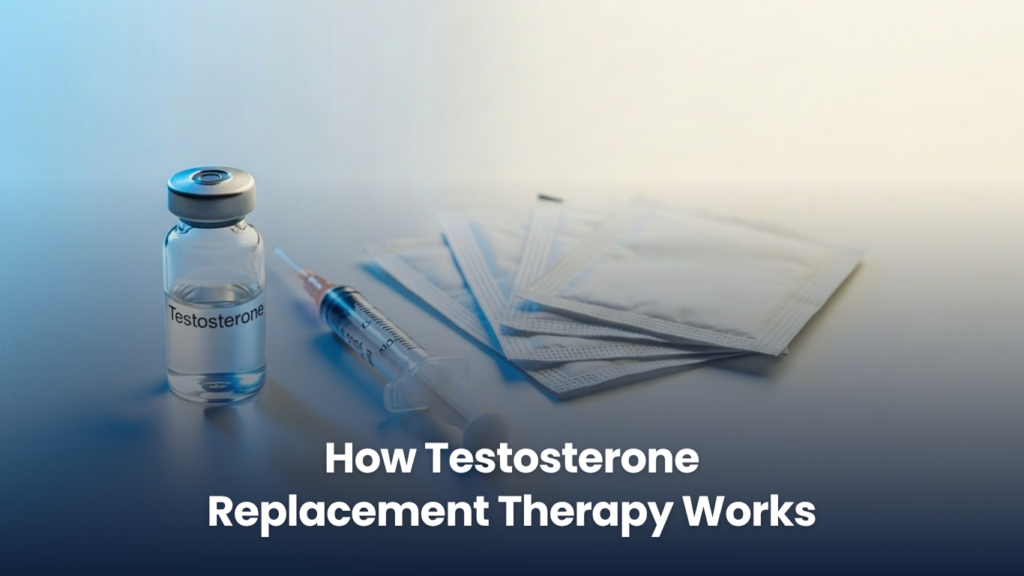
Testosterone replacement therapy, TRT, delivers exogenous testosterone directly into the body, bypassing the hormonal signaling process altogether. Rather than stimulating your body to produce more testosterone, TRT replenishes the hormone directly. At TRT Nation, injectable testosterone is the most used form of TRT, for several clinically supported reasons:
- Injections provide consistent, predictable testosterone levels with no transfer risk
- They allow for precise dosing adjustments based on bloodwork
- They avoid the absorption variability associated with creams, gels, and patches
- They are cost-effective and simple to administer at home once trained
TRT is an extremely well-established treatment with decades of clinical data supporting its safety and efficacy. The American Urological Association provides clinical guidelines on testosterone deficiency diagnosis and treatment, underscoring that TRT is a safe, evidence-based intervention when supervised.
The critical clinical consideration with TRT is that introducing exogenous testosterone suppresses the body’s natural hormonal signaling loop. When the brain senses adequate circulating testosterone, it reduces output of luteinizing hormone (LH) and follicle-stimulating hormone (FSH). These are the hormones that signal the testes to produce testosterone and sperm.
Natural testosterone production slows or stops, testicular volume often decreases, and sperm production is significantly suppressed. For men who are not concerned with fertility and who have exhausted or cannot use stimulatory approaches, this is an acceptable and manageable trade-off. Men who want to preserve fertility or are considering having children, this is a clinically meaningful concern that shifts the conversation toward enclomiphene. For more information on TRT and family planning, read TRT and Fertility: What Every Man Needs to Know About Starting a Family.
 How Enclomiphene Works
Enclomiphene is a selective estrogen receptor modulator, or SERM. Rather than introducing testosterone from an external source, enclomiphene works upstream, at the level of the pituitary gland, to restore the body’s natural testosterone production pathway.
Specifically, enclomiphene blocks estrogen receptors in the pituitary and hypothalamus. Because estrogen is part of the feedback loop that suppresses LH and FSH release, blocking those receptors signals the pituitary to increase LH and FSH output. Elevated LH and FSH then stimulate the testes to produce more testosterone and, critically, more sperm.
This is the key distinction in the TRT vs enclomiphene conversation: TRT replaces testosterone. Enclomiphene restores testosterone. The difference in mechanism produces a very different profile of outcomes, particularly for younger men and men with secondary hypogonadism.
 What the Research Says About Enclomiphene
The clinical evidence for enclomiphene is robust and consistently supportive. A subsequent Phase III analysis published in PubMed found oral enclomiphene raised testosterone to normal levels and preserved sperm counts. A 2024 systematic review and meta-analysis published in PMC (PubMed Central) analyzing randomized controlled trials through July 2024 found that SERM therapy including enclomiphene significantly increased total testosterone compared to placebo, with a mean testosterone improvement of approximately 274 ng/dL, while maintaining a favorable safety profile.
At standard clinical doses of 12.5 to 25 mg per day, enclomiphene has been shown to raise testosterone levels into the normal physiological range in men with secondary hypogonadism, while simultaneously maintaining the integrity of the HPG axis, something TRT does not do.
 TRT vs Enclomiphene: A Side-by-Side Clinical Comparison
Understanding the clinical profile of each treatment is the foundation of making an informed decision. The table below outlines the key differences between TRT and enclomiphene:
| Factor | Testosterone Replacement Therapy (TRT) | Enclomiphene |
| Mechanism | Delivers exogenous testosterone directly into the body | Stimulates the pituitary to produce LH/FSH, driving natural testosterone production |
| Administration | Weekly or bi-weekly injections | Daily oral tablet |
| Fertility Impact | Suppresses sperm production; can cause infertility | Preserves and can improve sperm counts |
| Testicular Function | Often causes testicular atrophy over time | Maintains testicular size and function |
| Speed of Results | Faster testosterone restoration | Gradual, natural rise in testosterone |
| Best Candidate | Men with primary or severe secondary hypogonadism | Younger men, secondary hypogonadism, fertility goals |
| Hormone Axis | Suppresses natural HPG axis | Preserves and restores the HPG axis |
| Monitoring Required | Regular bloodwork | Regular bloodwork |
It is important to understand that this table is a general reference. Individual eligibility for either treatment depends on specific lab values, symptom severity, health history, and provider assessment. The TRT vs enclomiphene decision is ultimately a clinical one, made in partnership with a qualified provider based on your unique hormonal profile.
 Who Is a Good Candidate for Enclomiphene?
Enclomiphene is not the right treatment for every man with low testosterone. It is specifically indicated for men whose low testosterone is rooted in a disrupted signaling pathway, secondary hypogonadism, where the testes retain the ability to produce testosterone when properly stimulated.
Enclomiphene tends to be the preferred clinical option for men who meet one or more of the following criteria:
- Younger men (typically under 40) who are not yet experiencing severe primary testicular failure and whose HPG axis remains functional
- Men who want to preserve fertility or are actively planning to have children and cannot risk suppression of sperm production
- Men with secondary hypogonadism confirmed by lab work showing low testosterone
- Men who prefer oral administration and want to avoid weekly injections
- Men who want to avoid testicular atrophy and maintain natural testicular function
- Men at the early stages of hormonal decline who still have responsive testicular function
If you are unsure whether your symptoms indicate low testosterone or are uncertain about the underlying cause, the Hormone Readiness Assessment at TRT Nation is a helpful first step. It helps you understand your symptoms and determine whether a full clinical evaluation and lab work is the right next move.
 Who Is a Good Candidate for TRT?
TRT remains the gold standard for men whose testosterone deficiency cannot be adequately addressed through stimulatory approaches. It is appropriate for a broader population and remains one of the most extensively studied hormone therapies in men’s health.
TRT is typically the preferred approach for:
- Men with primary hypogonadism where the testes themselves are unable to produce sufficient testosterone regardless of pituitary signaling
- Men with more severe or long-standing testosterone deficiency that has not responded to stimulatory treatments
- Men who are not concerned with fertility and whose family is complete
- Older men whose testicular function has diminished to the point where stimulatory treatments are unlikely to produce adequate results
- Men who have failed enclomiphene or SERM therapy and require direct testosterone replacement to achieve symptomatic relief
TRT at TRT Nation is a supervised, monthly membership-based program. Medications are shipped discreetly to your door. Consultations are conducted via secure telehealth video. Lab monitoring is ongoing, transparent, and included in the clinical process.
 Enclomiphene and Fertility: Why It Changes the Conversation
The fertility question is one of the most important factors in the TRT vs enclomiphene decision, particularly for men in their 20s, 30s, and early 40s. Standard TRT suppresses the HPG axis, which means it also suppresses spermatogenesis, the process by which sperm are produced. In some men, this suppression can persist for months after stopping TRT, and in some cases it may be prolonged.
Enclomiphene does the opposite. By stimulating LH and FSH production, it actively supports spermatogenesis alongside testosterone production. Research published on PubMed confirms that enclomiphene is effective in increasing serum testosterone in hypogonadal men while maintaining sperm counts, a combination that exogenous testosterone cannot replicate.
For men who are actively trying to conceive, who want to keep the option of biological children open, or who simply want to maintain natural reproductive function during treatment, enclomiphene is the clinically superior option. This is not a minor distinction, it is one of the most significant differences in the TRT vs enclomiphene comparison, and one that every man in his reproductive years should understand before beginning any testosterone treatment. For a deeper exploration of this topic, read Enclomiphene: Enhance Your Testosterone Optimization While Preserving Fertility.
 What to Expect on Each Treatment Path
TRT
The timeline for TRT is relatively predictable when the protocol is properly managed. Most men begin noticing improvements in energy, mental clarity, and mood within six weeks. Libido often follows. Body composition changes, more muscle, less fat, typically become visible around the twelve-week mark. Full hormonal stabilization, as reflected in lab work, generally occurs between three and six months. TRT Nation’s blog on month 2 vs month 6 on TRT provides a detailed timeline of what to expect throughout the treatment journey.
Enclomiphene
Enclomiphene produces a more gradual increase in testosterone because it relies on the body’s own hormonal machinery rather than direct delivery of the hormone. Most men begin to see shifts in energy and mood within four to eight weeks. Physical and libido improvements follow a similar timeline to TRT, though the rate of increase varies by individual. Monitoring on enclomiphene includes regular bloodwork. Enclomiphene increases LH and FSH, unlike TRT, which suppresses them.
 The TRT vs Enclomiphene Decision: A Framework for Thinking It Through
When weighing TRT vs enclomiphene, these are the questions that matter most clinically:
- What are your fertility goals?
If preserving fertility is a priority, now or in the future, enclomiphene is the clinically preferred option. TRT is contraindicated as a first-line therapy for men actively trying to conceive.
- What is your age and stage of hormonal decline?
Younger men with earlier-stage hormonal decline and functional testicular capacity are more likely to respond well to enclomiphene. Older men or those with more significant or long-standing testosterone deficiency may require TRT for adequate symptom resolution.
- What is your preference for administration?
Enclomiphene is a daily oral tablet, simpler for some, preferable for those who travel frequently or are needle-averse. TRT is most effective when administered via injection, typically weekly or bi-weekly.
- Have you tried stimulatory therapy before?
Men who have previously tried and failed to respond adequately to enclomiphene or other SERM therapies may be better served by transitioning to TRT under medical supervision.
If you are ready to get clarity on your hormonal health, the Hormone Readiness Assessment is a straightforward way to assess your symptoms and determine whether clinical evaluation is the next step.
 Why Proper Monitoring Matters on Both Treatments
Whether you are on TRT or enclomiphene, the quality of your outcomes is directly tied to the quality of your monitoring. Unsupervised use of either treatment, purchased without prescription or managed without regular bloodwork, is clinically unsafe and counterproductive.
For both treatments, ongoing monitoring should include:
- Total testosterone and free testosterone
- Estradiol (E2): elevated estrogen can occur on both TRT and enclomiphene and may require management
- PSA: relevant for men over 40 on TRT
- General metabolic and lipid markers
At TRT Nation, all treatment protocols are supervised by licensed providers. Ongoing clinical oversight ensures that your protocol is adjusted as your body responds. You can read more about how the clinic’s approach to testosterone optimization works, including injectable vs oral options, in the blog post Injectables or Enclomiphene? The Best Low T Options for 2026
 Frequently Asked Questions (FAQs): TRT vs Enclomiphene
Can I switch from enclomiphene to TRT if it is not working?
Yes. If enclomiphene does not produce adequate testosterone restoration after a supervised trial period, typically six months, transitioning to TRT is a clinically supported next step. The decision is based on follow-up bloodwork and symptom evaluation by your provider. At TRT Nation, providers work with patients through this process, adjusting protocols based on how your body responds over time and ensuring that the transition, if needed, is medically sound and well-managed.
Will enclomiphene affect my mood or estrogen levels?
Because enclomiphene stimulates testosterone production, rising testosterone can also lead to increased estrogen conversion through a process called aromatization. For most men this remains within a manageable range, but elevated estradiol can cause symptoms like mood changes, water retention, or reduced libido in some individuals. Regular bloodwork is used to monitor estradiol levels throughout treatment and adjust, if needed. At TRT Nation, this monitoring is built into every treatment protocol.
How is the TRT vs enclomiphene decision made at TRT Nation?
The decision is made collaboratively between the patient and a licensed provider, based on lab results, a detailed health history, symptom assessment, and the patient’s goals, including fertility intentions. There is no generic protocol at TRT Nation. Every patient receives an individualized evaluation, and the treatment path, whether TRT, enclomiphene, or an integrated protocol, is built around the specific biology and goals of that individual.