

Enclomiphene for Testosterone and Fertility: What Men Need to Know Before Starting Hormone Therapy
Last Updated April 2026
If you have been living with persistent fatigue, low libido, poor concentration, or a sense that something is just off, and you suspect low testosterone may be the reason, you are not alone. Millions of men across the United States deal with the symptoms of hypogonadism every year. Yet for many men, a single question stands in the way of seeking treatment: “What will this do to my fertility?”
That question is one of the most important questions you can ask. The good news is that modern hormone optimization has evolved significantly, and there is a clinically supported option that allows men to address low testosterone symptoms without sacrificing their ability to start or grow a family. That option is enclomiphene.
This guide explores how enclomiphene for testosterone and fertility works, what the clinical research shows, and how TRT Nation builds fertility-conscious protocols around it so that your health goals and your family planning goals work in the same direction. If you’re not sure if low testosterone is affecting you, take the Hormone Readiness Assessment to find out in minutes.
 Why Low Testosterone and Fertility Concerns Often Collide
Testosterone is the primary male sex hormone responsible for energy, muscle mass, mood regulation, libido, cognitive sharpness, and, critically, sperm production. When testosterone levels fall below optimal ranges, the downstream effects ripple across nearly every system in the body.
Symptoms of low testosterone commonly include:
- Chronic fatigue that does not improve with sleep
- Low sex drive or sexual dysfunction
- Difficulty building or retaining muscle mass
- Brain fog and poor concentration
- Mood changes, including irritability or low mood
- Decreased motivation and drive
- Increased body fat, particularly around the midsection
These symptoms are real, disruptive, and treatable. But here is where the concern around fertility enters the picture: the most common first-line treatment, exogenous testosterone replacement therapy, works by delivering testosterone from an outside source. When your brain detects that testosterone levels are sufficient, it reduces signaling to the testes. Specifically, it lowers the release of luteinizing hormone and follicle-stimulating hormone, the very hormones that drive sperm production.
The result is that standard TRT, while effective at relieving low testosterone symptoms, can cause a significant reduction in sperm count and, in some cases, temporary infertility. For men who are actively trying to conceive or want the option to do so in the future, this is an understandable dealbreaker. That is precisely why enclomiphene for testosterone and fertility has become one of the most relevant conversations in men’s health today.
 What Is Enclomiphene and How Does It Work?
Enclomiphene citrate is a selective estrogen receptor modulator (SERM), a class of medication that interacts with estrogen receptors throughout the body to produce targeted hormonal effects. Unlike exogenous testosterone, which bypasses your body’s own hormonal signaling, enclomiphene works upstream by stimulating the hypothalamic-pituitary-gonadal (HPG) axis.
Here is a simplified look at how that process works:
- Blocks estrogen feedback at the hypothalamus and pituitary: Estrogen normally signals the brain to reduce LH and FSH output. Enclomiphene blocks this feedback loop.
- Triggers increased LH and FSH release: With the brake released, the pituitary gland increases its output of both hormones.
- Stimulates the testes to produce more testosterone and sperm: LH signals testosterone production; FSH drives spermatogenesis, the formation of new sperm cells.
The critical distinction is this: enclomiphene does not suppress your body’s natural hormonal axis. It stimulates it. Your testosterone goes up. Your sperm production continues. Both outcomes are achieved through your body’s own biological machinery.
 What the Clinical Research Shows About Enclomiphene for Testosterone and Fertility
The evidence base for enclomiphene in men with secondary hypogonadism is both meaningful and growing. Here is a summary of what the research tells us:
Testosterone Normalization
Multiple clinical trials have demonstrated that enclomiphene citrate at doses of 12.5 mg and 25 mg significantly increased total testosterone levels in hypogonadal patients. Men who did not respond optimally to standard doses could be adjusted more easily due to the drug’s short half-life.
Fertility Preservation
This is where the evidence for enclomiphene for testosterone and fertility is most compelling. A landmark study published in the Journal of Sexual Medicine (Kaminetsky et al., 2013) demonstrated that three months of enclomiphene therapy stimulated sperm production alongside testosterone. Men maintained stable or higher sperm concentrations compared to baseline. A separate randomized trial confirmed that enclomiphene effectively preserved fertility while restoring testosterone levels.
Safety Profile
A comprehensive PMC study found that enclomiphene maintains a favorable safety profile, with lower rates of documented adverse events. Enclomiphene does not carry the risks of testicular atrophy, erythrocytosis (excess red blood cell production), or the cardiovascular concerns sometimes associated with long-term exogenous testosterone use.
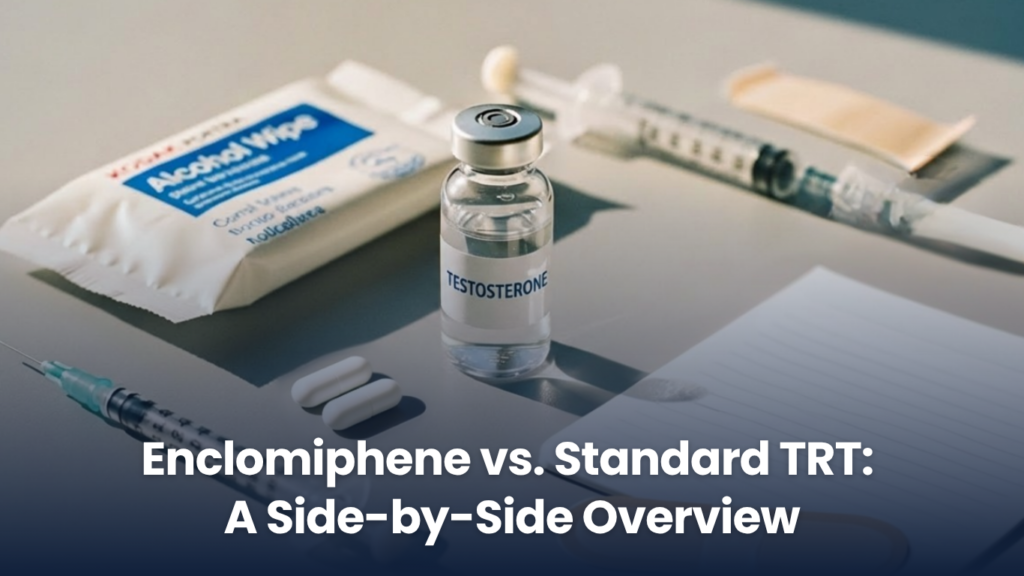 Enclomiphene vs. Standard TRT: A Side-by-Side Overview
The table below is intended as an educational reference. Your personal protocol should always be determined by a qualified medical provider based on your labs, symptoms, and goals.
| Feature | Enclomiphene | Standard TRT |
| Mechanism | Stimulates body’s own testosterone production via HPG axis | Delivers synthetic testosterone directly |
| Fertility Impact | Preserves, maintains LH, FSH & sperm production | Suppresses, reduces sperm count significantly |
| Administration | Oral daily pill | Injections, gels, patches, or pellets |
| Spermatogenesis | Maintained or improved | Often reduced; may cause oligospermia |
| Testicular Size | Preserved | Risk of shrinkage/atrophy |
| Onset of Effect | 4–8 weeks for testosterone normalization | 2–4 weeks for initial symptom relief |
| Best For | Men with family planning goals or secondary hypogonadism | Men with severe symptoms, no fertility concerns |
| Monitoring Required | Yes, regular bloodwork | Yes, regular bloodwork |
For a deeper breakdown of how these options compare for 2026, read TRT Nation’s Guide: Injectables or Enclomiphene? The Best Low T Options for 2026.
 Who Is a Good Candidate for Enclomiphene?
Enclomiphene is not a universal solution, but for a well-defined group of men, it is an exceptionally well-matched therapy. The following table summarizes who tends to benefit most, based on current clinical guidance.
| Profile | Good Candidate for Enclomiphene? | Notes |
| Planning to have children within 1–3 years | Yes | Fertility preservation is the primary benefit |
| Secondary hypogonadism (pituitary-related low T) | Yes | Targets the root cause upstream |
| Prefers oral medication over injections | Yes | Simple daily pill protocol |
| Wants to preserve natural testosterone production | Yes | Does not suppress the HPG axis |
| Primary hypogonadism (testicular failure) | Discuss with provider | May need TRT or combined approach |
| Severe, immediate symptoms requiring rapid relief | Discuss with provider | TRT + adjunct may be more appropriate |
If you are unsure which category you fall into, the Hormone Readiness Assessment is a useful starting point before speaking with a provider.
 Understanding the Fertility Timeline: What to Expect
One of the most important things men need to understand when thinking about hormone optimization and fertility is that the body does not operate on a short timeline. Whether you are using enclomiphene as a standalone protocol or alongside other therapies, realistic expectations matter.
Key Fertility Timeline Facts:
- About 4 weeks: Initial testosterone improvements begin.
- About 8 weeks: Optimal testosterone levels typically achieved with consistent dosing.
- About 3 months: Sperm production begins to respond meaningfully to hormonal signaling.
- About 6 months: Mature, viable sperm development is typically complete, the minimum window before optimized fertility.
This is why TRT Nation’s clinical guidance emphasizes starting fertility support early, not when you are actively trying to conceive, but well before. Proactive planning gives your body the time it needs to respond fully.
For men already on standard TRT who are now considering starting a family, the path to fertility restoration is still very possible. As TRT Nation explains, with proper planning and the right fertility support protocols, most men can successfully restore their fertility while managing their hormonal health.
 How TRT Nation Incorporates Enclomiphene into Fertility-Conscious Protocols
TRT Nation takes a comprehensive, individualized approach to hormone optimization. Rather than applying a one-size-fits-all protocol, every patient’s treatment plan is developed based on their lab work, symptom profile, lifestyle, and goals, including family planning goals.
Here is how that process generally works for men interested in using enclomiphene for testosterone and fertility support:
- Comprehensive initial testing: Bloodwork is ordered upfront to assess total testosterone, CMB, CBC, estradiol, sperm parameters (when relevant), and other key markers.
- Personalized protocol development: Based on your results and goals, a provider designs an integrated protocol. For fertility-conscious patients, this may center on enclomiphene or incorporate adjunct fertility support options with your TRT therapy.
- Ongoing monitoring: Regular follow-up bloodwork ensures your protocol is optimized over time, not just started and forgotten.
- Education and support: Providers at TRT Nation take the time to explain the process, set realistic expectations, and guide patients through the timeline of what to expect.
Importantly, TRT Nation offers standalone enclomiphene therapy to new patients. This approach reflects a core clinical principle: hormone optimization works best when treated as a system, not a single variable. Read more about this philosophy in TRT Nation’s enclomiphene overview.
 You Do Not Have to Choose Between Health and Fertility
For men who have been told by a primary care provider that their testosterone is “borderline” or who have simply resigned themselves to feeling low-energy, foggy, and disengaged, this is the point worth sitting with: the symptoms of low testosterone are not something you have to endure because you want to protect your fertility.
Enclomiphene for testosterone and fertility offers a clinical pathway where both objectives are addressed simultaneously. You can pursue meaningful symptom relief, restored energy, improved libido, clearer thinking, better body composition, while your sperm production remains intact and your hormonal axis continues to function as it was designed to.
Living with untreated low testosterone carries its own long-term health implications. Chronically low testosterone has been associated with:
- Adverse metabolic outcomes
- Changes in cardiovascular health markers
- Reduced bone density
- And a measurably lower quality of life
Treating it is not a cosmetic or optional decision; it is a health decision.
 The Bottom Line on Enclomiphene for Testosterone and Fertility
Low testosterone does not have to come with a tradeoff. For men who are managing symptoms of hypogonadism while protecting their reproductive future, enclomiphene for testosterone and fertility represents a clinically supported path that honors both priorities.
By working upstream through your body’s own hormonal system, rather than bypassing it, enclomiphene allows men to restore energy, mood, libido, and body composition without suppressing the biological processes that make conception possible.
If you are ready to understand where your hormones stand, start with TRT Nation’s Hormone Readiness Assessment. And if you are ready to speak with a provider who takes your fertility goals as seriously as your health goals, TRT Nation is built for exactly that conversation.
 Frequently Asked Questions
Does enclomiphene increase testosterone levels to a meaningful degree?
Yes, multiple clinical trials have demonstrated that enclomiphene citrate at doses of 12.5 mg and 25 mg raises total testosterone levels in hypogonadal men. Unlike exogenous testosterone, this increase is driven by your body’s own hormonal signaling rather than an external source. TRT Nation uses laboratory monitoring to ensure your levels are optimized appropriately throughout the protocol.
Will enclomiphene protect my fertility if I want to have children in the future?
This is one of the most well-supported benefits of enclomiphene. Clinical studies show that men using enclomiphene maintained stable or improved sperm counts, while men on testosterone therapy experienced significant reductions. TRT Nation’s fertility-conscious protocols are built specifically around this evidence for men who want both hormonal optimization and preserved reproductive potential.
How is enclomiphene different from standard testosterone replacement therapy?
Standard TRT delivers testosterone externally, which causes the brain to reduce its output of LH and FSH, the hormones that drive both testosterone production in the testes and sperm formation. Enclomiphene instead stimulates the body’s own hormonal axis to produce more testosterone naturally, without shutting down gonadotropin signaling. This is why enclomiphene for testosterone and fertility is considered a fundamentally different therapeutic approach rather than a variation of TRT. TRT Nation helps patients understand which pathway is appropriate based on their individual labs and goals.
Can I use enclomiphene if I am already on testosterone replacement therapy?
For men already on standard TRT who now want to restore or protect their fertility, transitioning to or adding enclomiphene to support HPG axis reactivation is a clinical conversation worth having. Some protocols use enclomiphene adjunctively alongside TRT, while others use it as part of a transition strategy, the approach depends entirely on your hormonal baseline and goals.